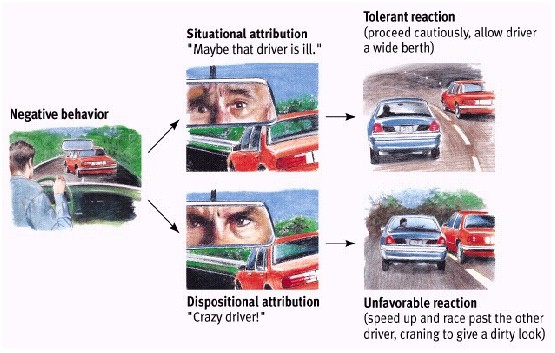
 occurs when one tends to
overestimate the dispositional factors and underestimate the situational factors
when explaining someone else's behaviour.
occurs when one tends to
overestimate the dispositional factors and underestimate the situational factors
when explaining someone else's behaviour. Social Cognition
Social Cognition - examines the effect of social
situations or influences on thought, memory & perception.
Attribution Theory - involves understanding the ways in which motivation can alter our perceptions of responsibility for ourselves and others.
Kelly's Attribution Model
Three characteristics lead to personal or
situational attributions
| Consensus | Distinctiveness | Consistency | Outcome |
| Low - other people don't | Low - P does in any event | High - P always does this | Personal Attribution |
| High - other people do | High - P does this only during this event | Low - P doesn't always do this | Situational Attribution |
Attributions are the implicit or explicit statements about causality and the source of human action or responsibility.
Situational attributions occur when one identifies some environmental factor as the cause of action or behaviour.
Dispositional attributions are made when one's actions are deemed to be the direct result of a personal trait or motive.
Fundamental Attribution
Error
occurs when one tends to
overestimate the dispositional factors and underestimate the situational factors
when explaining someone else's behaviour.
Across cultures - Americans make more personal attributions while Indians make more situational attributions.
Self-Serving Bias occurs when one explains one's own failures to the situation and successes to one's own personal characteristics.
-Both tend to be more prevalent in 'western' countries
Just-World Hypothesis
occurs when one believes that the world is a fair and just place and that people
get what they deserve. >Victim blame.
Attitudes and their social origins
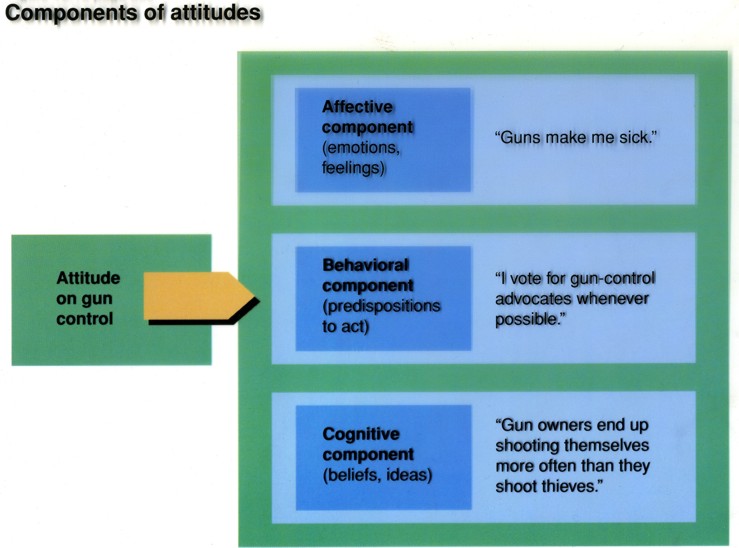
Attitudes are relatively stable opinions that we have which are comprised of both cognitive and emotional components.
Vary in strength and flexibility of conviction and arise through social means such as cohort effects where a generational identity emerges: boomers, gen-X or gen-Y
Attitudes often influence behaviour,
more often behaviour influences attitudes.
Cognitive Dissonance 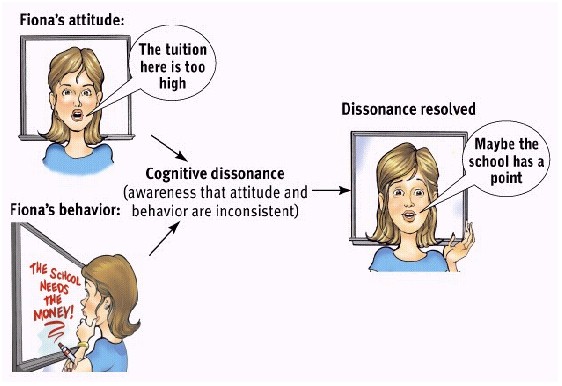 is
said to occur when two contradictory attitudes are being held at the same time,
or when behaviour and attitudes diverge. Thought that people are motivated to
reduce dissonance.
is
said to occur when two contradictory attitudes are being held at the same time,
or when behaviour and attitudes diverge. Thought that people are motivated to
reduce dissonance.