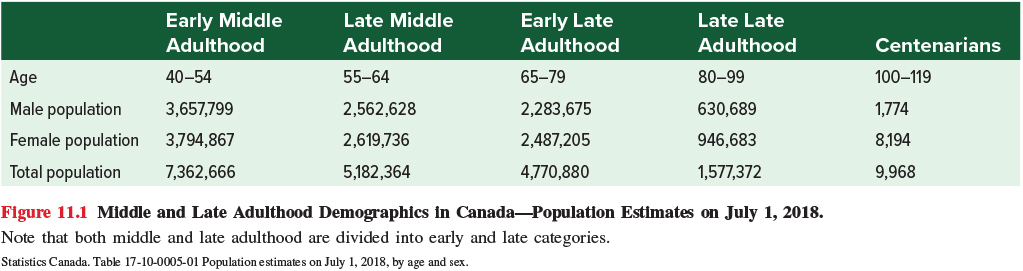
The concept of “late adulthood,” beginning in the sixties/seventies and lasting until death, is a recent developemnt
While physical and cognitive gains and losses often balance each other in early midlife, losses tend to outweigh gains for many individuals in later midlife
Middle adulthood is a period where people become more conscious of the "young-old polarity" of our society and the lessening amount of time left in life in comparison to life lived
Individuals often come to seek transmiting something meaningful to next generation
Overall, aging is not about how many years but more so about health/fitness of body and mind
Evolutionary theory of aging suggests that natural selection is linked to reproductive fitness where by in virtually all species, females outlive males
Women generally have stronger immune systems and have more resistance to infections/degenerative diseases
Men tend to engage in risk-taking and physical activities
Cellular clock theory (Hayflick) - indicates that cells can divide a maximum of about 75 to 80 times and as we age our cells become less capable of dividing
Aging is very complex process involving multiple degenerative factors:
1) interacting cell- and organ-level communications
2) some individual aging triggers
3) biological aging has multiple processes operating at different levels
4) female estrogen helps protect arteriosclerosis (hardening arteries)
5) X chromosome may be associated with antibodies to fight disease
Sex differences in mortality are less pronounced in late adulthood however men have higher level of cardiovascular disease than women
We live in a society where a youthful appearance is highly valued, especially for women. One of the most visible signs of change in middle and late adulthood is in our physical appearance:
Strength deteriorates
sarcopenia - age-related loss of muscle mass and strength, especially in back and legs
arthritis - inflammation of joints accompanied by pain, stiffness, movement problems
osteoporosis - characterized by loss of bone mass, increased bone fragility, risk of fractures;
four times as common in women as in men joints and bones (maximum bone density in mid-late 30s, cartilage, ligaments, tendons degrade and stiffen)
mobility issues increase (often related to obesity) often leading to use of canes and walkers
falls become more likely and damaging (risk of falling increases with age; greater for women) and is leading cause of hospitalization among Canadian seniors
Vision
Accommodation of the eye (ability to focus/maintain image on the retina; declines sharply between 40 and 59 years, unable to focus oin close objects, decline in night vision)
Cataracts form as a thickening of the lens of the eye that causes vision to become cloudy and distorted
Glaucoma is also more likely which involves a damage to optic nerve by fluid build up
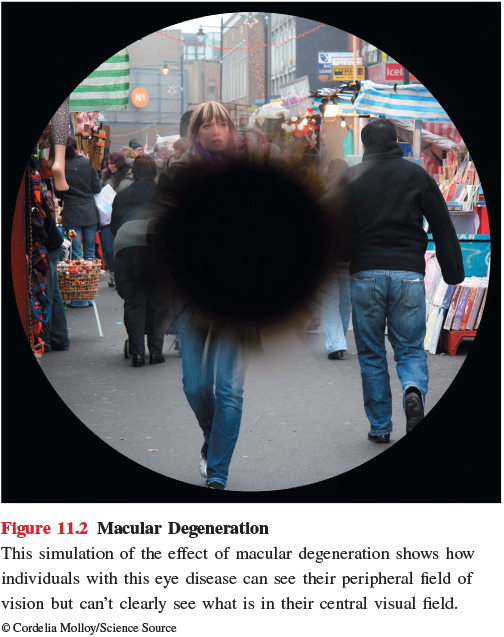
Macular degeneration also becomes more common
Hearing and Smell
Overall sensitivity to high pitches usually declines first with age; men usually lose their sensitivity to high-pitched sounds sooner
Most older adults lose some of their sense of smell or taste or both
Changes in touch and pain are also associated with aging and the presence of pain increases with age in older adults
An estimated 60 - 75 percent older adults report at some persistent pain; back pain (40 percent), peripheral neuropathic pain (35 percent), chronic joint pain (15 to 25 percent)
Women are more likely to report having pain than men
Chronic stressors linked to downturn in immune system functioning; although many auto-immune disorders are more likely as we age, especially among women (lupis, fibromyalgia)
Changes in heart and blood vessels occur as we age; cardiovascular disorders increase in late adulthood where for both men and women, resting blood pressure increases with age
Voices noticeably change because our lung capacity drops 40 percent between the ages of 20 and 80, even without disease as lungs lose elasticity, chest shrinks, diaphragm weakens
Sleep - app. 50 % of older adults complain of having difficulty sleeping ; older adults’ sleep is lighter and more disrupted
Climacteric - midlife transition during which fertility declines
Menopause - time in middle age when menstrual periods cease completely
Male hypogonadism - condition in which the body does not produce enough testosterone
Erectile dysfunction - difficulty in attaining or maintaining an erection, is present in approximately 50 percent of men 40 to 70 years of age
Small changes in brain loss occur except for those developing demential and early onset alzheimer's disease, but can be moderated by "brain exercises" that maintain or enhance cognitive abiltiies and integration of ideas and memories
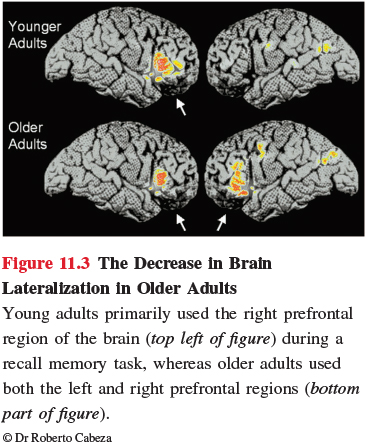
Lateralization begins to decrease with age where the specialization of function in one hemisphere of the brain is reduced
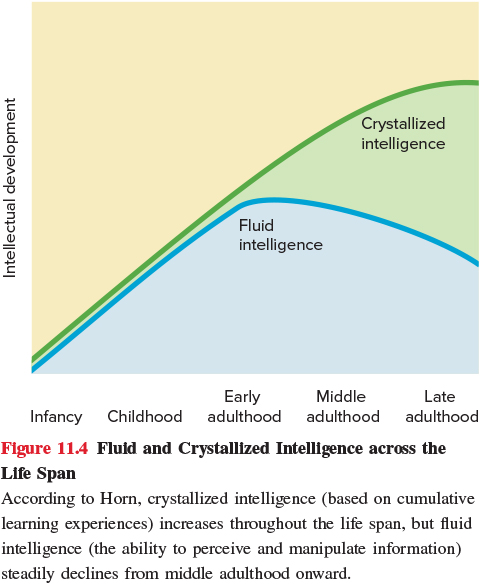
Crystallized intelligence, an individual’s accumulated information and verbal skills, continues to increase in middle adulthood
Fluid intelligence - ability to reason abstractly; begins to decline during middle adulthood
These trends vary depending on whether data are collected cross-sectionally or longitudinally can make a difference in what is found
Working memory of the mental “workbench” where individuals manipulate and assemble information when making decisions, solving problems, and comprehending written and spoken language tends to decline in late middle age
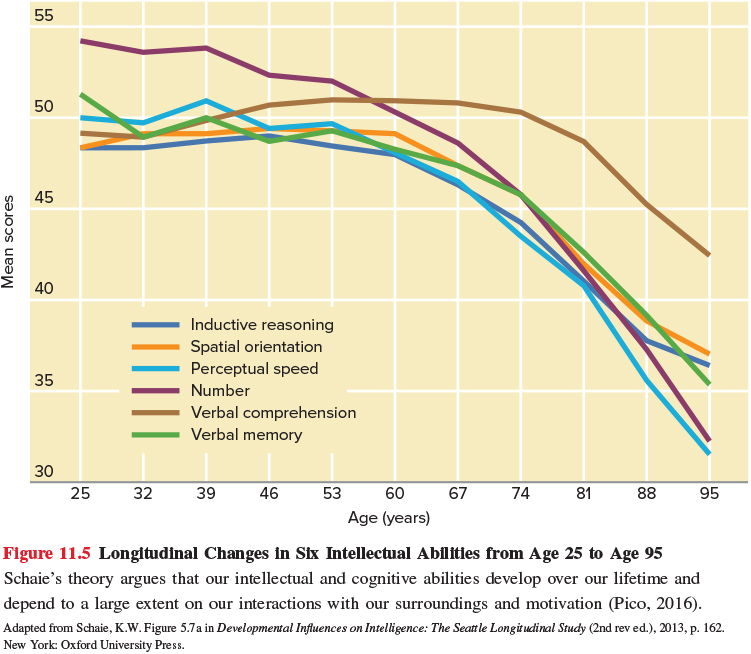
Explicit (declarative) memory - memory of facts and experiences that individuals consciously know and can state begins to show some decline (senior momnets)
Implicit memory - memory without conscious recollection; involves skills and routine procedures, such as driving a car; less affected by aging
Episodic memory - retention of information about life’s happenings largely remains intact until later years
Semantic memory - person’s knowledge about the world remains stable
Wisdom - expert knowledge about practical aspects of life that permits excellent judgment about important matters. It invovles more than standard conceptions of intelligence; focuses on life’s pragmatic concerns and human conditions and comes to develop later in life.
Sustained attention - ability to focus attention on a selected stimulus for a prolonged period of time
older adults often perform as well as middle-aged and younger adults
Speed of information processing declines slightly in mid-age
When older adults engage in complex working tasks/challenging daily work activities, cognitive functioning shows less age-related decrease
Changes in cognitive activity patterns might result in disuse and consequent atrophy of cognitive skills therefore" use it or lose it"
Neuroplasticity - ability of brain to change continuously over life span reduces in aging where changes in brain can influence cognitive functioning and changes in cognitive functioning can influence the brain
Dementia - global term for any neurological disorder where primary symptoms involve deterioration of mental functioning caused by loss of brain cells and breakdown of nerve connections
Alzheimer’s disease is a progressive, irreversible brain disorder characterized by a gradual deterioration of memory, reasoning, language and eventually physical functioning. it is the most common form of dementia
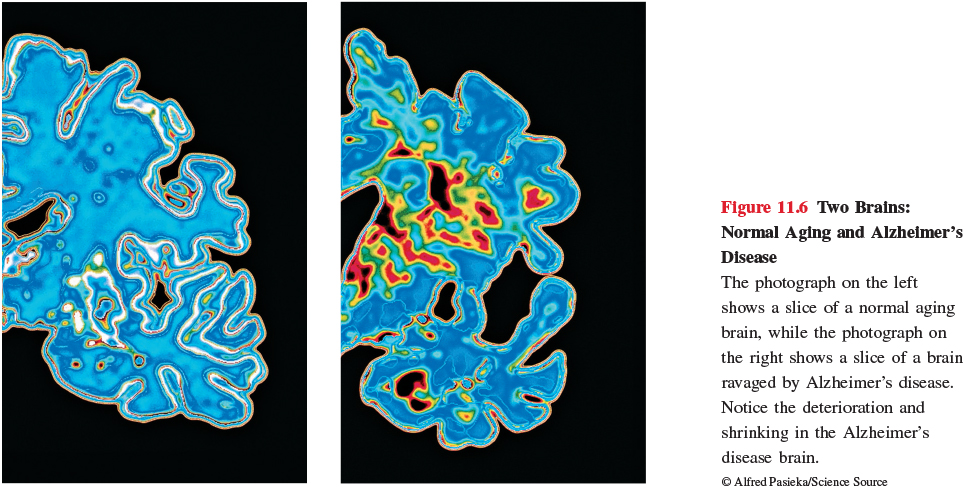
Once the destruction of brain tissue occurs from Alzheimer’s disease, it is unlikely that treatment of the disease will reverse the damage
Some amelioration can occur through regular contact with family and working on memories as well as music therapy
Deterioration characterized by the formation of amyloid plaques (dense deposits of protein in the blood vessels) and neurofibrillary tangles (twisted fibres built up in neurons) composed mainly of a protein called tau
Mild cognitive impairment (MCI) - represents transitional state between the cognitive changes of normal aging and very early Alzheimer’s disease and other dementias
Parkinson’s disease - results from loss of cells in the brain that produce dopamine, a chemical that controls the body’s movements; tremors can develop, muscle movements become slower/more rigid; reflexes impaired, contributing to a loss of balance
It is second to Alzheimer’s as most common neurodegenerative disorder and is chronic, progressive disorder with no known cause
The role of work is central during the middle years
Age-related declines occur in some occupations, but for most jobs, no differences have been found in the work performance of young adults and middle-aged adults
One's ability to work effectively peaks during middle age (increased motivation, work experience, employer loyalty, better strategic thinking)
Quality of work by middle-aged employees linked to how much work is appreciated/how well they get along with immediate supervisors
Religion is a powerful influence in some adults’ lives, whereas it plays little or no role in the lives of others
Women participate more in both organized/personal forms of religion; more likely to believe in a higher power or presence; more likely to feel that religion is an important dimension of their lives
Spirituality - search for meaning in life through a connection to something larger than ourselves; broad concept with many individualized perspectives
Researchers have found that religious attendance is linked to a reduction in hypertension
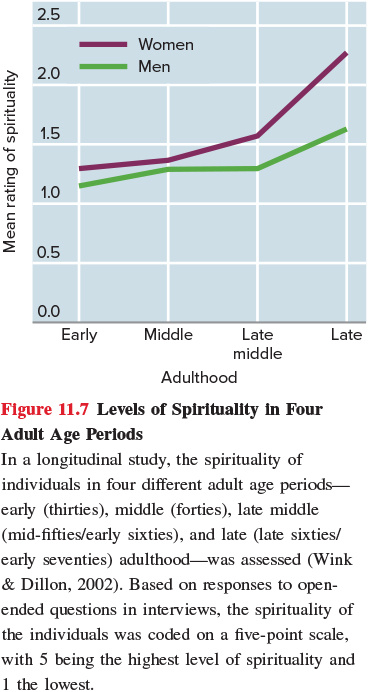
Religion offers comfort and social support when individuals are confronted with stressful events
Examining the finiteness of our existence and the certainty of death adds meaning to life
As people become increasingly aware of the diminishing number of years, many begin to ask/evaluate the meaning of life; meaning-making is especially helpful in times of chronic stress and loss
A sense of meaning can lead to clearer guidelines for living one’s life and enhanced motivation to take care of oneself and reach goals
