Erikson's Generativity vs Stagnation is the mid life stage (7) of development where adults face the issues around giving to the next generation versus being self absorbed and self focused. As we become parents, teachers, leaders and role models we have the opportunity to give to the younger generations and guide them into their identities.
This can happen with infants and their needs for hope, school age children and their need for purpose, adolescents and their need for identity fidelity or anyone of any age. In giving of one self to others rather than being self possesed one comes to develop the virture of Care, something essential to generativity and guiding others through the processes of mutuality and cogwheeling.
Integrity vs despair is the 8th an last of the original stages of development. This is where in old age invidividuals are facing the crisis of looking at their lives and reflecting on meaning and importance of how they have lived as they move toward to the end. If one is able to reflect on the past and look to the dwindling future it is possible to live with integrity and a holness and comfort of life.
On the other hand one faces despair as the days become numbered and one's future is shortened, here one might fall into a crisis of meaninglessness. Wisdom is the ego virture that arises through the optimal navigation of this life stage, where giving through the depth of one's experiences and knowledge can help with the generativity, love, fidelty etc for others.
In their later years, Erik and Joan Erikson began to look at a potential ninth stage of development, one that Joan published in 1997 after Erik's death. This is the stage of very old age (of one's 80s & 90s) where Joan points out that the syntonic (positive pole) is waning and the dystonic (negative pole) is accellerating in one's life.
Here she reports that Mistrust comes to be dominant over Trust for the very old as they learn to no longer trust their bodies and minds. Likewise Shame and doubt come to outweight Automony, Guilt over Initiative, Identity confusion over Fidelity, Isolation over Intimacy, Stagnation over Generativity and finally Despair over Wisdom.
Gerotranscendence
This is a time of the unwinding of life and facing the troubling challenges that comes as our bodies, minds and social relations come to an end. This is seen in the elderly care homes where often even the most basic functions like feeding need to be assisted. She does howerver offer a vision from wisdom to build better communities for the elderly to gain strength from younger people living in their midst while they can continue to give of their ego virtues as times descends upon them and they face death (as in our last topic of this course).
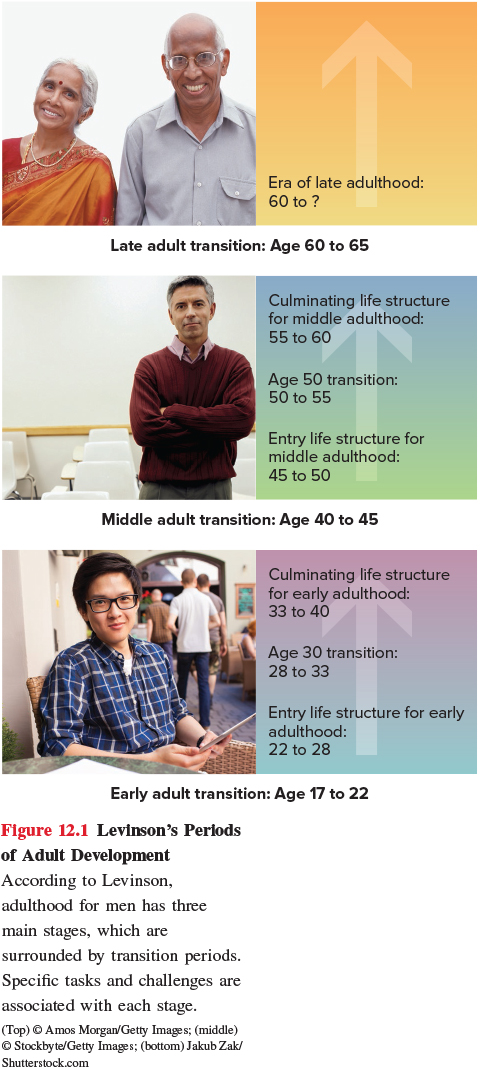
Novice phase of adult development - end of teen years; transition from dependence to independence should occur; formation of a dream (image of the kind of life the youth wants to have – career, marriage)
Early adult, becoming one’s own man (or BOOM) -28 to 33, man goes through a transition period facing more serious question of determining his goals
Moving to the middle, during thirties, he usually focuses on family and career development while by age 40, he has reached stable point career; has outgrown his earlier, more tenuous attempts at learning to become an adult; now must look forward to the kind of life he will lead as middle-aged adult
Transition to middle adulthood lasts about 5 years (ages 40 to 45) and requires the adult male to come to grips with four major conflicts that have existed in his life since adolescence:
70-80% find midlife transition tumultuous/psychologically painful, as many aspects of their lives came into question
The middle-aged adult is suspended between past/future, trying to cope with this gap that threatens life’s continuity
Vaillant (1977) - just as adolescence is a time for detecting parental flaws and discovering the truth about childhood, forties are decade of reassessing/recording the truth about adolescence and adulthood, not a crisis
A second major way to conceptualize adult personality development is to focus on life events.
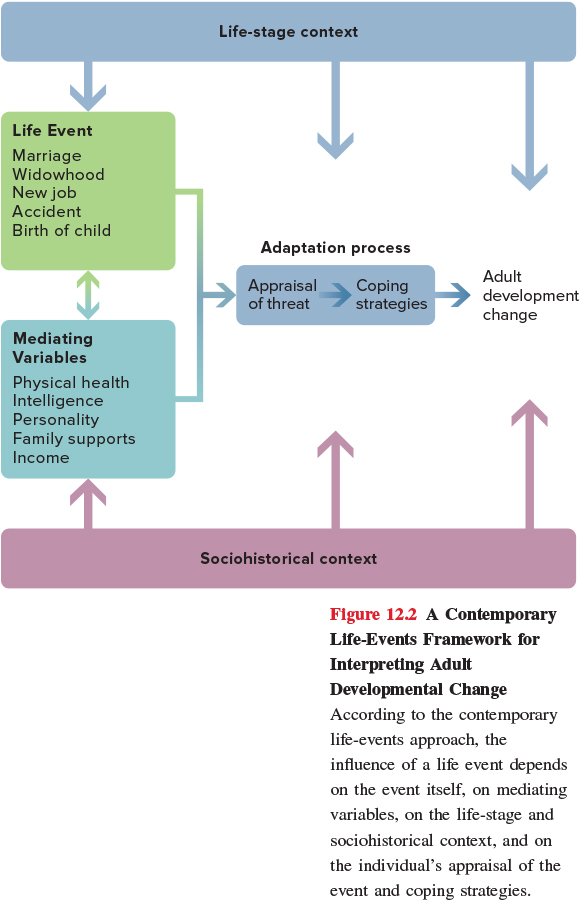
The contemporary life-events approach - emphasizes how life events influence individual development depending the life event itself/mediating factors (e.g., physical health, family supports) affect and are affected by individual adaptation to the life event (e.g., appraisal of the threat, coping strategies), life-stage context and sociohistorical context
(Lachman, Teshale, & Agrigoroaei, 2015) - personal control changes when individuals move into middle age
Middle age is when person’s sense of control is frequently challenged by demands and responsibilities, as well as physical and cognitive aging
While young people more prone to sense of invulnerability, unrealistic view of personal control and a lack of awareness regarding the aging process middle age people give less attention given to self-pursuits/responsibility for others
Middle adulthood is largely of one’s own making, which can be stressful as individuals face take on/juggle responsibilities in different areas of life
Stress and personal control in midlife
Some aspects of personal control increase with age/others decrease
A sense of control in middle age is one of the most important modifiable factors in delaying the onset of diseases in middle adulthood and reducing the frequency of diseases in late adulthood
Typically, women more vulnerable to social stressors (romance, family, work) and more prone to higher stress if things go bad in romantic/marital relationships
Women are also more likely than men to become depressed when they encounter stressful life events such (divorce, death of a friend); engage in tend-and-befriend (social alliances with others, especially female friends)
A central tenent is that active/involved older adults more likely to be satisfied with their lives
People age more successfully and are happier than they are if they disengage from society
Socioemotional selectivity theory - older adults more selective about social networks; place high value on emotional satisfaction; spend more time with familiar individuals with whom they have had rewarding relationships
Selective optimization with compensation theory - successful aging linked with three main factors: selection, optimization, compensation (SOC).
The most stable characteristics are the degree to which individuals were intellectually oriented, self-confident, open to new experiences
The characteristics that changed the most were the extent to which the individuals were nurturant or hostile/self-control was strong or weak
Social participation by older adults is often discouraged by ageism
Late adulthood poverty linked to more physical/mental health problems
Marriages that were difficult and rocky during early adulthood become more stable in middle adulthood; eventually discover a deep and solid foundation on which to anchor their relationship
The perils of divorce can be fewer/less intense than for younger individuals where emotional and time commitment to a marriage may not be lightly given up. Even though change is desired, it is hard to initiatve, giving up decades of commitmtent and life patterns, resources accumulation and friendships.
Many midlife individuals perceive a divorce as a failure
Empty nest syndrome - often includes a decline in marital satisfaction after children leave home as much of their lives together had previous revolved around their children, however, for most, marital satisfaction does not decline after children have left home.
Here, partners have more time to pursue careers and other interests and have time for each other where the empty nest can increase marital satisfaction , increasing quality of time spent with partners
Friendships are as important in middle and late adulthood as they were in early adulthood
It takes time to develop intimate friendships; friendships that endured over the adult years often deeper than those formed in mid-adulthood.
When parents are unable to look after their children, grandparents or aunts and uncles often step in
Middle-aged adults share their experience and transmit their values to the younger generation
Adult daughters are three times as likely as adult sons to give parents assistance with daily living activities
A decrease in social activity of many older adults may reflect greater interest in spending more time in the small circle of friends and family
Older adults often tend be less lonely than younger adults and typuically engage in more volunteer hours also giving a greater proportion of all donations that come from that demographic
Being active and engaged is especially important for successful aging
Older adults who are emotionally selective, optimize their choices, and compensate effectively for losses increase their chances of aging successfully
Successful aging also involves perceived control over the environment (Lachman, Agrigoroaei, & Hahn, 2016). In recent years, the term self-efficacy has often been used to describe perceived control over the environment and the ability to produce positive outcomes