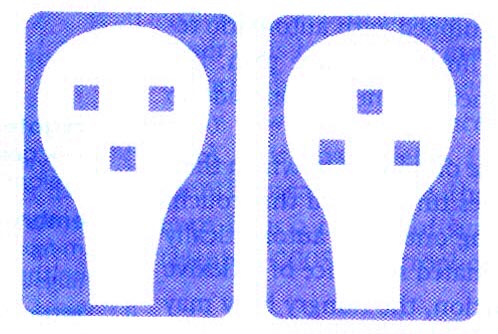
Physical and motor development is incredibly rapid where brain grows & becomes more complex.
Developmental trend goes from cephalo to caudal and proximo-distal. This means from head to tail and center to periphery.
Birth - to about 12 months gross motor development includes:
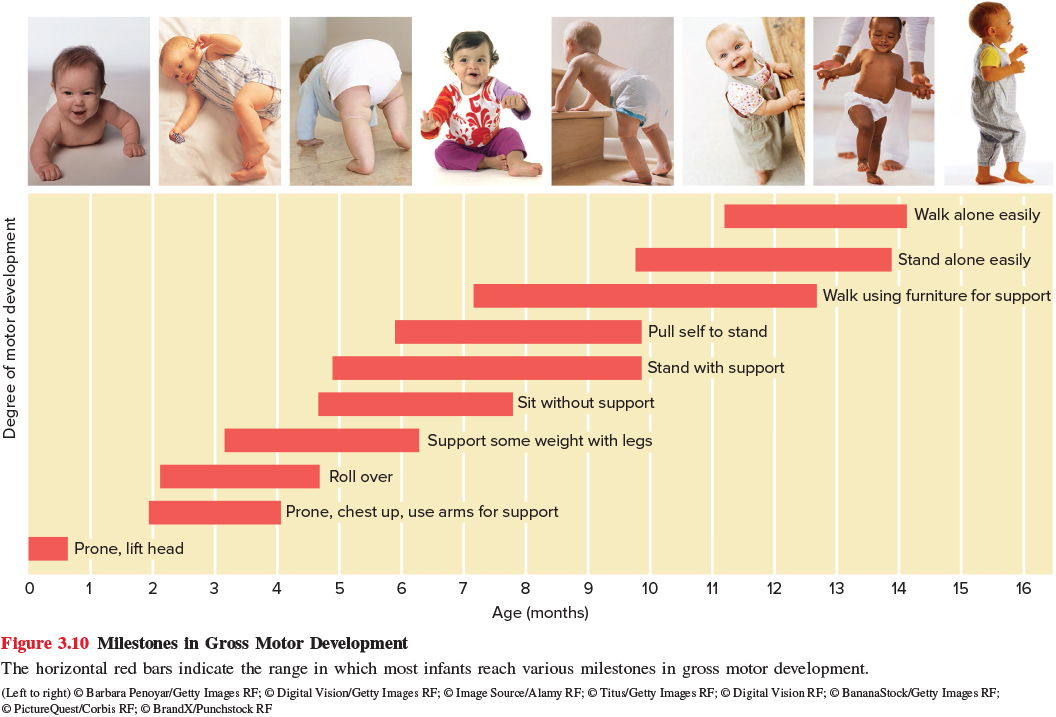
During the second year (From 12 mo – 2 years) there is slower growth and an increase motor activities
Children have irregular growth patterns alternative weight and height gains.
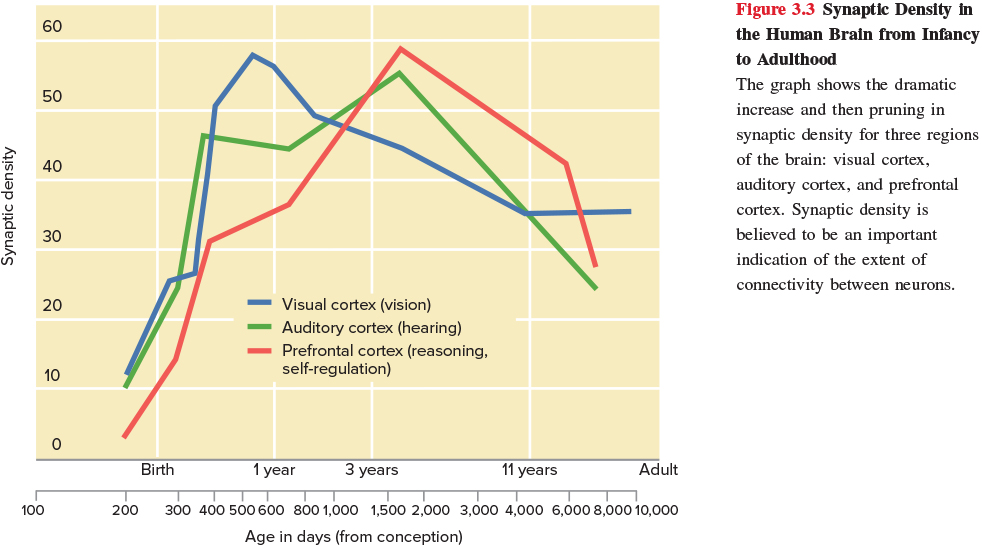
There is extensive brain development from birth through infancy but it slows down relative to body development where by about 2 years the brain about 75% of adult brain weight.

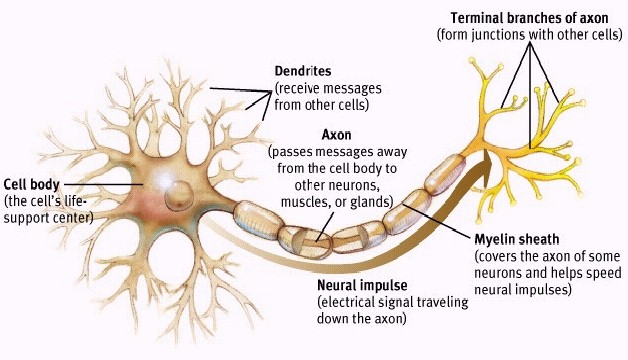
Neurons: Cells that conduct electrochemical signals, the basic unit of the nervous system. Also called a nerve cell. Arborization .
Cell Assemblies are collections of cells that work together in neural pathways or circuits .
Glial Cells: cells that hold neurons in place, insulate neurons, and provide neurons with nutrients.
Nerve - a bundle of nerve fibres (axons and dendrites) in the peripheral nervous system.
The Structure of the Neuron
Dendrites - a neuron's branches that receive information from other neurones and transmit it toward the cell body.
Cell Body - The part of the neuron that keeps it alive and determines whether or not it will fire.
Axon - a neuron's extending fibre that conducts impulses away from the cell body and transmits them to other neurons.
Myelin sheath - A fatty insulation (oligodendrocytes ) that may surround the axon of some neurons, also called white matter. After birth develops in sensory and then motor areas, and in adolescence through to pre-frontal cortex.
Synapse - place where transmission of nerve impulses go from one neuron to the next. alt fig
- Includes the axon terminal, the synaptic cleft, and receptor sites in membrane of the next cell.Action potential - Electrical impulses or current travelling down nerve cell. Two types of action. video, AP2
unmyelinated smooth flow of current or potential
myelinated jumping skipping flow of potential hopping down nodes fig
Synaptic end bulb - synaptic vesicles - little sacs that release neurotransmitters . video
Neurotransmitter - a chemical substance that is released by a transmitting neuron at the synapses and that alters the activity of a receiving neuron.eg.,
acetylcholine - transmits between nerves and muscles and
in Pons (REMSleep) ; also memory & learning
dopamine - important in " reward " system, important in
schizophrenia & Parkinson's syndrome ;
also learning, movement and emotion
serotonin - involved in sleep, dreaming, mood,
arousal & emotions ( SS )
GABA - involved in inhibition and regulation of anxietyReceptor sites - lock and key only certain ones fit.
excitatory - increase potential of receptor firing
inhibitory - decrease probability of receptor firing
Neuromodulators - chemical messengers in the NS that increase or decrease the action of specific neurotransmitters. Drugs will affect action of neurotransmitters : release, re-uptake, block, ...
E.g., Cocaine blocks re-uptake of dopamine leading to longer effects then lowered levelsEndorphins - chemical substances in the nervous system that are similar in structure and action to opiates; they are involved in pain reduction, pleasure, and memory and are AKA endogenous opioid peptides.
Prenatal period - most of development is directed by genes to establishes basic wiring patterns of the brain
Postnatal periods- much greater influence of environmental experiences guide the brain’s development:
sights, sounds, smells, touches, language and eye contact shape neural connections
Brain stemthe part of the brain at the top of the spinal chord, consisting of the medulla and pons and midbrain.
Cerebellum - 'lesser brain' - a structure that regulates movement and balance, and timing that is involved in the learning of simple kinds of responses.
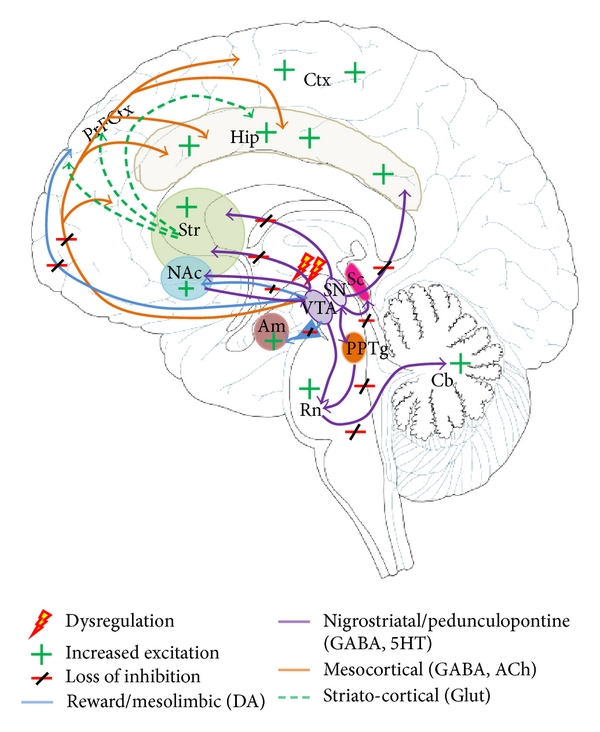
Limbic System - A group of brain areas involved in emotional reactions and motivated behaviour. -emotions and 'pleasure centre' (septal area) of rat brains as seen in repeated bar pressing in a study by Olds & Milner, 1954)Cerebral Cortex - several thin layers of cells covering the cerebrum, "grey-matter" cell bodies of the cortex "white-matter" is myelinated (covered) axons elsewhere in the brain
Cerebral cortex - four lobes on each side (or hemispehre) of the brain:
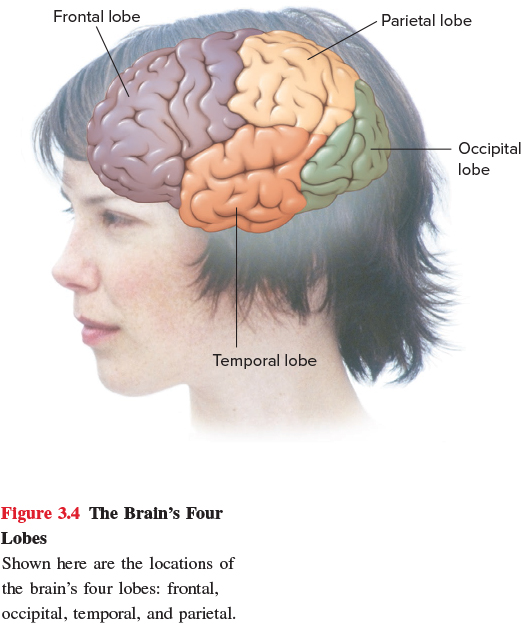 frontal lobes < temporal lobes < parietal lobes < occipital lobes
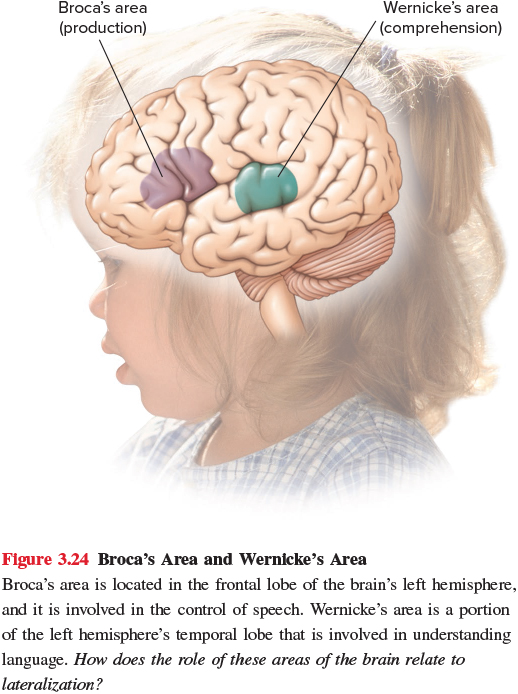
Lateralization - the specialized functioning of the two hemisperes of the brain, connected to each other through the Corpus Calossum
Laterialization of function / specialization starts before birth where each side of the body in terms of sensation and motor action is connected to the other side of the brain, and various abilities are primarily found in only one hemispere (i.e., language in the left hemisphere and spatial processing the in the right.
newborns - have greaterbrain activity in left hemisphere than right when listening to speech and in the right hemispere when listening to music
Later brain development indicates later maturity of later evolutionary structures, i.e.first the hind brain, then middle then forebrain and cortexes where Occipital is first to develop annd frontal lobes responsible for foresight, planning, abstract preparation are last to develop.
Sleep is crucial for both physical and cognitive development whereby infants who have tremendous growth in the brain and bodies sleep almost 16 hours per day and have the most REM or dreaming sleep as seen in sleep patterns across human development . REM sleep has been associated with memory and brain development.
Like other species, newborns have a number of reflexes or reactions to stimuli
At birth there are Reflexes several innate behaviours exist for neonates, including: grasping, rooting (feeding) and babinski (toes open then curl in - which is expected to reverse in time).
Reflexes allow all animals to make adaptive responses before significant expereince occurs
Rooting reflex - is an important one for human infants whereby if their cheek is touched infants will turn their heads toward that side in an apparent effort to find something to suck.

Dynamic Systems Theory - suggest that motor and perceptual development occur simultaneously each contributing to the other.
This is where things like eye-hand coordination occur where the various areas of the brain (visual, sensory and motor) are making neural connections.
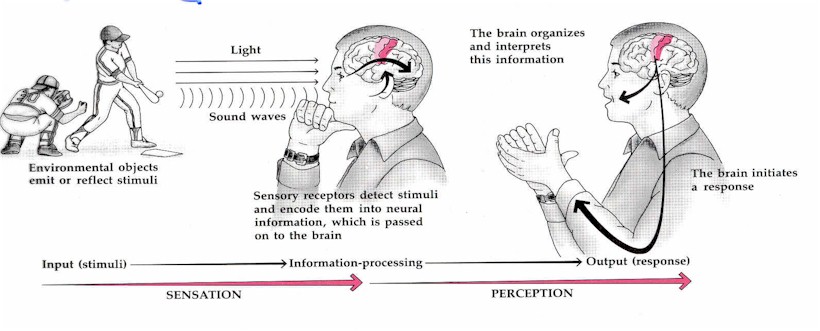
Sensation - is the detection of physical energy emitted or reflected by physical objects
Perception - The set of processes that organize and interpret sensory impulses. Allows us to identify objects.
Infants have visual preferences; tend to look at patterned objects (e.g. faces); less colour interest
Many of these abilities are examined through the habitution paradgim, where they see how long they pay attention to stimuli.
Together these processes allow researchers to tell if an infant can distinguish certain objects, colours, sounds etc; where by once habituated if a novel stimulus then garners a response the infanty is believed to perceive it differently from the original stimulus and if there is no response it is inferred that the infant cannot distinguish between stimulus one and two.
Visual acuity is not great for infants they tend to focus best on near objects (8-10 inches).
Visual preference Within minutes of birth infants turn head towards faces or bull's-eyes over others.
Ordered faces then scrambled faces were preferred within hours after birth. (Appears to be innate like other species).
Depth perception is present at 2 months when heart rate decrease for infants placed on " deep side " of visual cliff 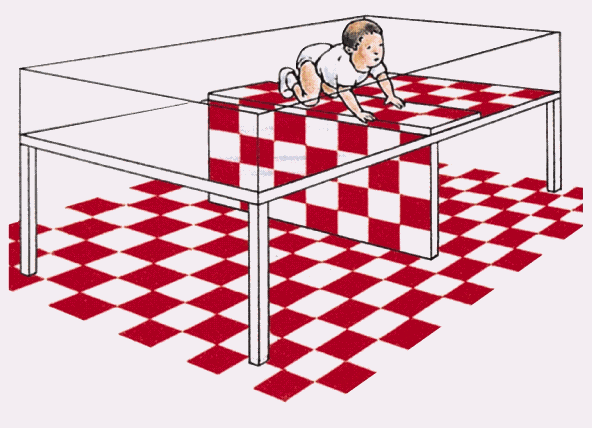
Auditory discrimination (and preference) - last few months in utero. New Borns 'prefer' their mother's voices and also stories, and music that they are familiar with.
Locate sounds in space (turn head to clicker @ 5 min) and prefer mother's voice to others'.
Also can distinguish between phonemes (e.g., ba , pa )
'Motherese' ( parentese ) is preferred (high pitched) along with Mozart over more discordant music.
According to Piaget, Cognition or knowing is built around notion of schemas or 'templates' for thinking. Patterns of thought are innate and unfold in a timely and order sequence:
Schemas go are used for assimilation of information into them, make sense of the world through our pre-existing categories of thought.
These schemas also under go accommodation where they themselves change or transform in time.
-This 'hard' stage model indicates that one moved forward through age-related transitions one way only (built from Kantian-Rationalist perspective regarding the forms of thinking as schemas).
1) Sensory motor (0-2) knowledge through sensing and moving things and self.
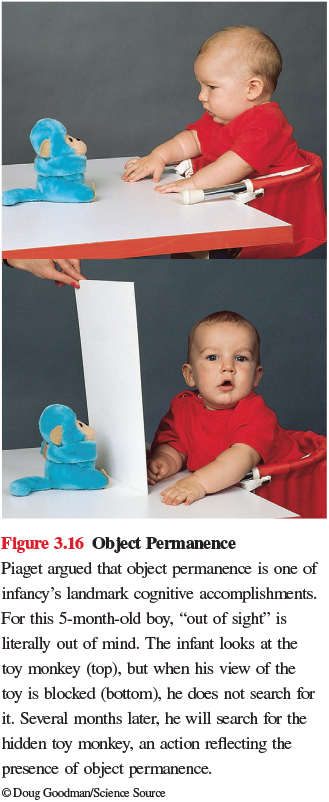
Gradually have the development of object permanence and symbolic thought.
Memory - is the retention of information over time whether for a short or long time
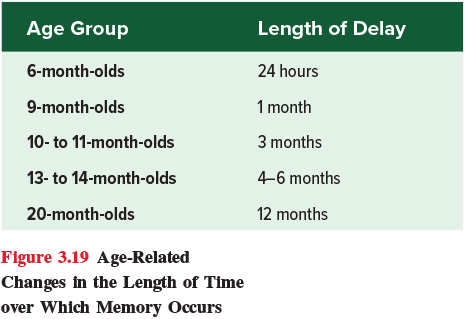
Autobiographical Memory
Infants appear to be sensitive to number of objects through 'expectations' and time looking.
Symbols - written or acoustical codes that make reference to and stand for real objects and actions, often displaced.
Sign - a mark or movement that is used to represent something or some action. ASL uses hand signs.
Phonemes - are the basic units of verbal language. Potentially can produce about 100 such sounds. English contains ~45, most languages vary between 20 & 80.
Morphemes - are the basic units of meaning that compose linguistic communication.
Semantics - is the study of the meaning behind language as communication. Meaning is generally unrelated to sounds.
Syntax - involves the rules governing the use of language units in conveying meaning (the grammar).
Humans appear to be infinitely generative in the production of novel expressions. Meaning is often implicit - sarcasm, irony, metaphor, even "make me an ice cream cone."
Skinner (1957) contends that language is learned like anything else, through operant conditioning. "tacts" and the association of a verbal stimulus become its foundation. Reinforcement keeps it going.
Challenges to this approach: reference to class or category not specific object.
Chomsky (1957) made a distinction between deep structure (meaning) and surface structure (what is said).
-The rules of language construction (syntax) enables multiple surface structures (sentences) and multiple deep (meanings).
This shows that we have a biological propensity for language and develop it in meaningful patters.
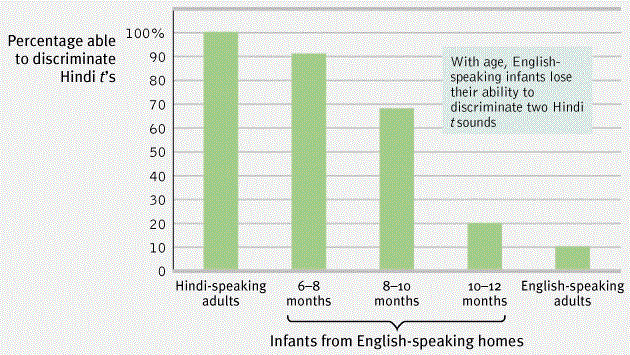
before learning words, infants make fine distinctions among language sounds
birth - to approximately 6 months infants can tell when sounds change regardless of language
after that our abilities to comprehend and produce phonemes from other languages is lost withouot use or expereince.
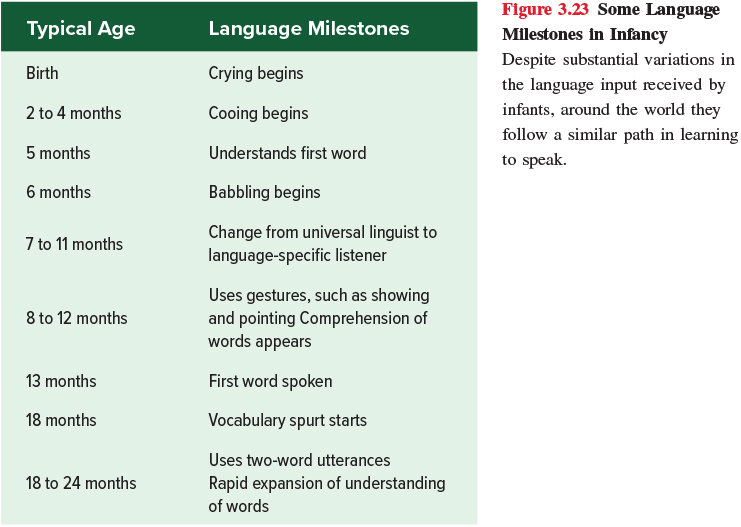
Schedule of Language Development
Infants babble, toddler's start around age two, systematic errors (over uses of rules) occur at specific ages (wented).
-6 months old respond to "mommy" or "daddy"
-7 months old detect phoneme pattern ga ti ga, ti bo bo, and familiar words
Recent studies have shown that early exposure to language (i.e. Cantonese) can have lasting effects even though it might not be remembered. (Listen to Quicks&Quarks Nov 22, 2014).
-The grammar "settings" get fixed and difficult to change for phoneme recognition and production. Also ASL
Appears to be strong innate innate capacity that requires experience for stimulation and not learned simply through reinforcement!
Biological Influences
Environmental Influences
Exposure to langague(s) is required to learn indicating that there is a critical period for the development of language is prior to 12 year (the case of Genie), but stimulation throughout early years maintains it. Accents and second languages become exceedingly difficult to acquire.