Brain and Music
Levitan (2006)
Chapter 3 - Behind the Curtain: music and the
mind machine
What is mind?
Descartes' gives us dualism,
today neuroscientists accept material monism
Brain research through lesion
studies, disease or accidental damage, stimulation and imaging.
Experience of music begins in
sub-cortical regions of cochlear nuclei, brain stem, cerebellum,
then to auditory and secondary association cortexes.
[image]
Many areas involved in musical
experience
Primary and
secondary auditory cortexes - experience
Hippocampus - memory of music
Motor & Sensory Cortexes (& basal areas) - Foot tapping, playing and moving
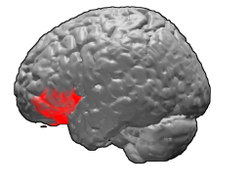
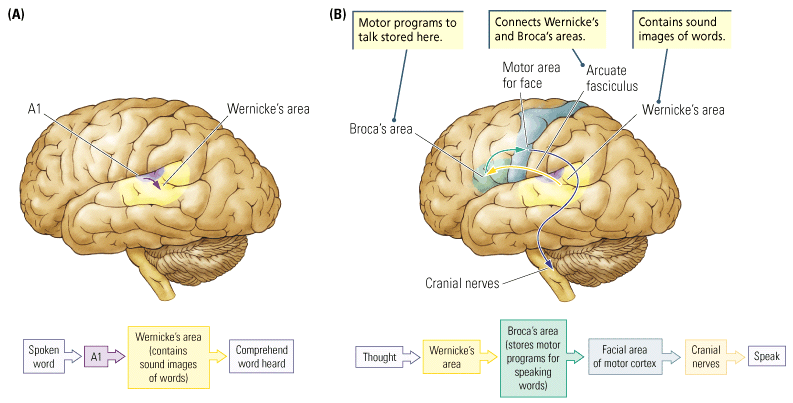
Temporal (Wernicke's area) - Listening to lyrics & making meaning
Temporal and Frontal - Singing
Where IS music experienced?
Dennett & Ramachandran - Where do you "see" pictures and "hear" music?
Gestalt Illusions and grouping of perceptions
Helmholtz, Stumpf, ... von Erenfehls, Wertheimer...
Grouping Principles
vs.
Feature Extraction
Bottom-Up - experience (low) to higher levels of organization
Top-Down - Higher order influence on perception (expectations)
Helmholtz - Unconscious Inference or logic of perception where we "fill in"
between stimuli into a sequence or larger whole. Gestalt.
Phi-phenomenon, similarity, proximity, good form,
Contemporary music producers attempt to manipulate these principles to create
"experiences".
"Sounds in your head" - manipulated "voices" IN your head.
Chapter 4 - Anticipation
Gives examples of anticipation in music, we expect the song to go .....there.
Musical syntax - some 'structural' processing in both Broca's and Wernike's
regions as well as the complementary areas in the right hemisphere.
fMRI has revealed the pars orbitalis and Brodmann's Areas 47 to be
involved,
likely
with temporal sequencing, since also active during signing with deaf persons.
Chapter 5 - You Know my Name: Look up my
number
Constructivist theory of thought - Like Reconstructed memory - Elizabeth Loftus
Split Brains - Specialized duties in each hemisphere - Michael Gazzaniga
Gestalt Identity of melody even with transposition, reversal, and tempo
changes - Benjamin White
We get
Gist (like Loftus)
But
also remember specific details like Luria's "S" who suffered from hypermnesia.
Categorization Rosch & Wittgenstein
Prototypes and family resemblances
just like conceptual categories, also consider music
Psycho-acoustics & Cognitive Psychology
Pitch
as a psychophysical phenomenon, what is absolute pitch?
Sight
singing and Earworms.
Sacks (2007)
Case Studies on Music and the brain, including
the areas of:
I. [being] Haunted by Music
1. Strike of lightning
2. Musical Seizures
3. Musicogenic Epilepsy
4. Imagery & Imagination
5. Brainworms & Catchy Tunes
6. Musical Hallucinations
II. A Range of Musicality
7. Sense and sensibility
8. Amusia & Dysharmonia
9. Absolute Pitch
10. Cochlear Amusia
11. Living in Stereo
12. Musical Savants
13. Music & Blindness
14. Synesthesia and Music
III. Memory, Movement and Music
15. Music and Amnesia
16. Aphasia and Music Therapy
17. Accidental Davening: Diskinesia and Cantillation
18. Music and Tourette's Syndrome
19. Rhyme & Movement
20. Parkinson's Disease and Music Therapy
21. Phantom Fingers
22. Musician's Dystonia
IV. Emotion, Identity and Music
23. Musical Dreams
24. Seduction and Indifference
25. Music and Depression
26. Music & Emotion (Harry S.)
27. Music & Temporal Lobes
28. Hypermusical Species: William's Syndrome
29. Dementia and Music Therapy
Peretz & Zatorre (2009)
Chapter 6 - The Roots of Musical variation in
perceptual similarity and invariance.
McAdams & Matzkin (pp. 79-94)
Perceptual similarity underlies many
psychological properties of musical materials,
including perceptual invariance under transformation,
categorization, recognition and sense of familiarity.
E.g. How far to vary
musical materials yet still perceive them as the same category.
Examined the form-bearing dimensions
-perceptual similarity-invariance
-musical variation
Musical Materials have three limiting
factors:
1) degree of match of volume of auditory
attribute events comparing sequence
2) relations at various levels of abstraction
3)grammar of musical systems
Chapter 7 - Tonal Cognition.
Kruwhansl &
Toiviainen (p.95)
Tonality examined through experimentally
quantified tonal hierarchies
Circle of fifths, both parallel & relative
major / minor key pairs were examined.
Tonal distributions - key finding
Tone transitions - pitch and temporal
distance between tones
Both practiced "trained" listeners on 9 - 10
chord sequence
Mapping of tonality used to visualize
activation patterns over time.
Chapter 9 - Neurobiology of harmony perception.
Tramo, Cariani, Delgutte & Braida (p. 127)
Vertical dimension of harmony examined
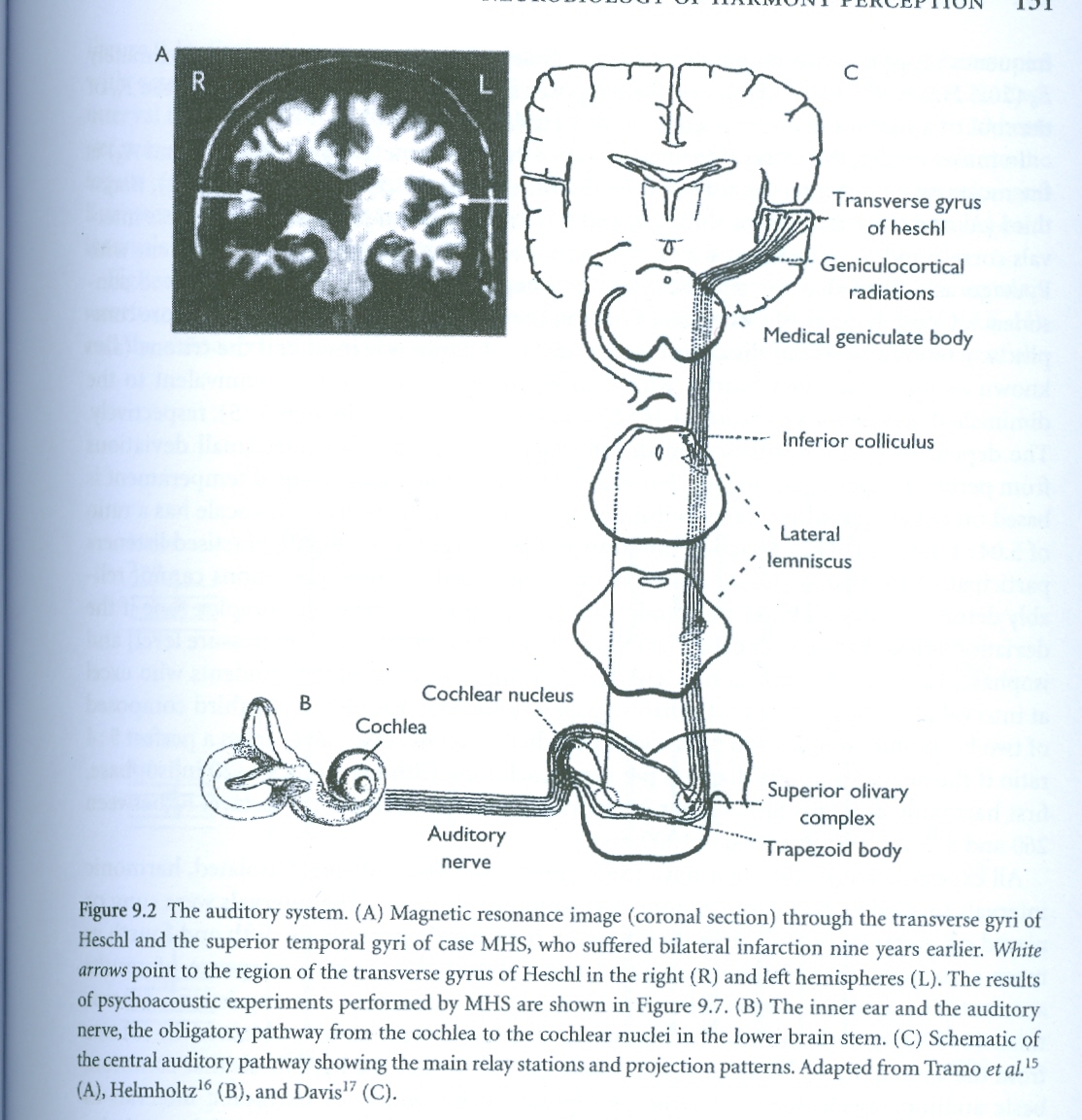
through various properties of auditory system:
Fig 9.1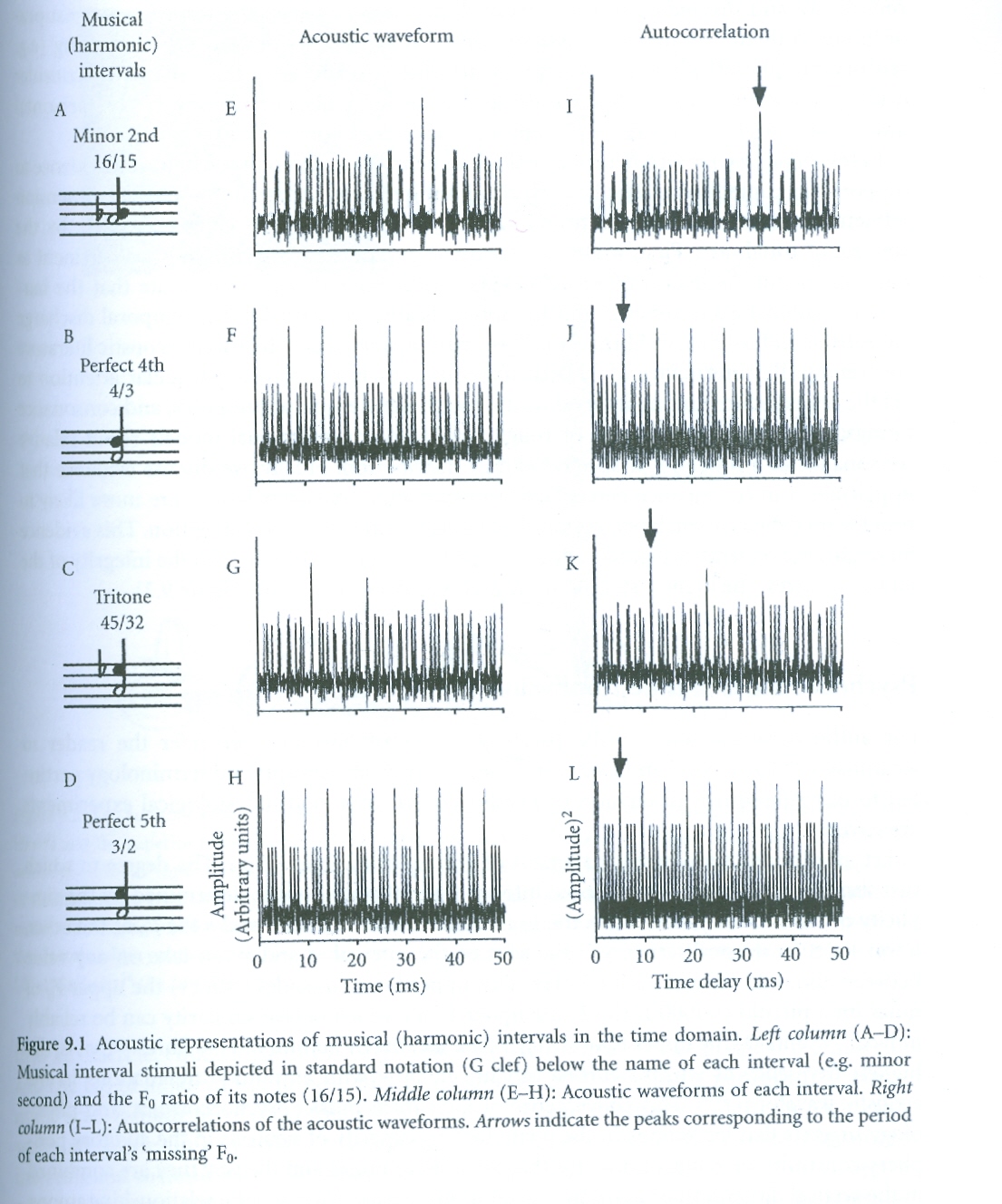 Fig 9.2 - Auditory system
  .
.
Examined:
1) the capacity of peripheral auditory
neurons to encode temporal regularities in acoustic fine structure.
2) the differential tuning of many neurons
throughout the auditory system to a narrow range of frequencies.
Consonant intervals - "fine timing of
auditory nerve fiber responses contains strong representations of
harmonically related pitches" (p.127) (E.G. Rameau's fundamental bass theory) where
"non-tonic harmony contained within it a dissonant seventh,
whether or not the seventh was articulated or audible" (Weinstein-Reiman, 2016, para. 4).
Dissonant intervals - auditory nerve
activation that does not contain strong representations of constituent notes
or related bass.
Chapter 10 - Intracerebral evoked potentials in
pitch perception reveal a functional asymmetry of human auditory cortex (p. 152)
Chapter 16 - Neural specializations for tonal
processing.
Zatorre (p. 231)
Processing pitch is central to music
perception and is also "neurally dissociable" (p.231)
Two Principle methods (lesion & imaging) used
to show that the right primary auditory cortex is crucial for "fine-grained" representation of pitch information.
Heschl's gyrus Fig 16.1
is the primary auditory cortex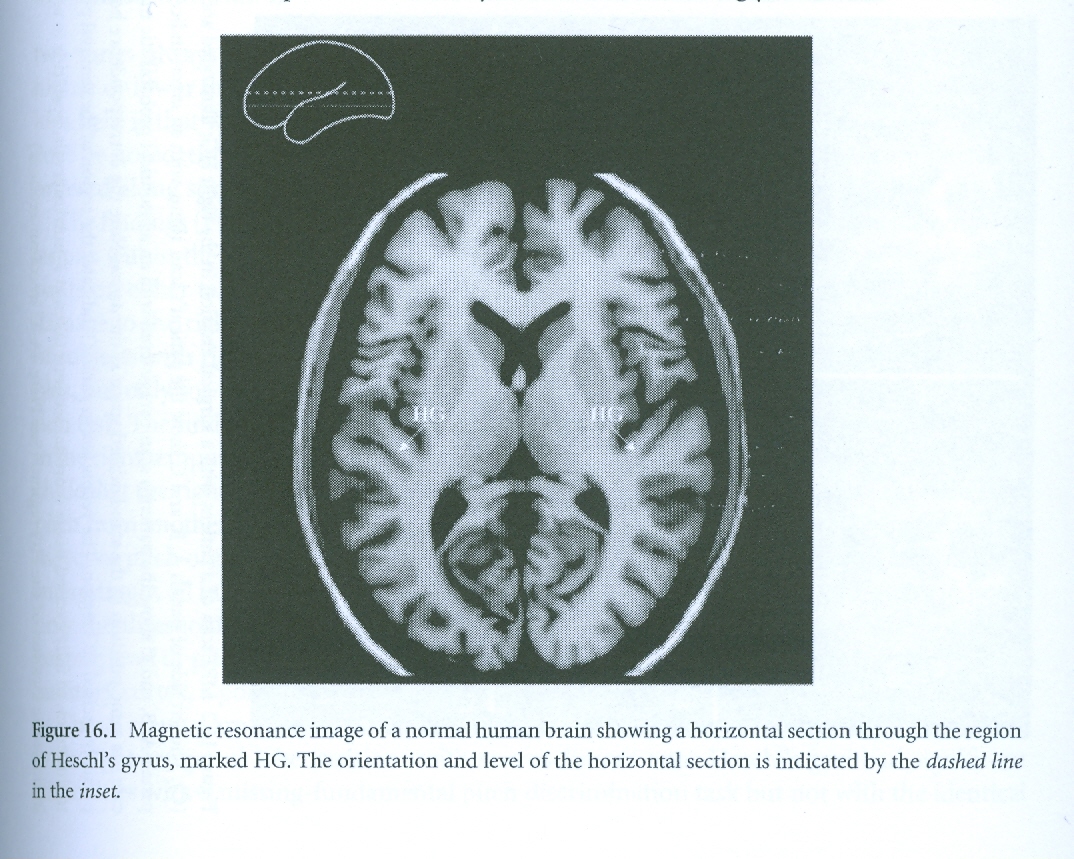
see also plate 4
for colour map of patient with surgery in this area.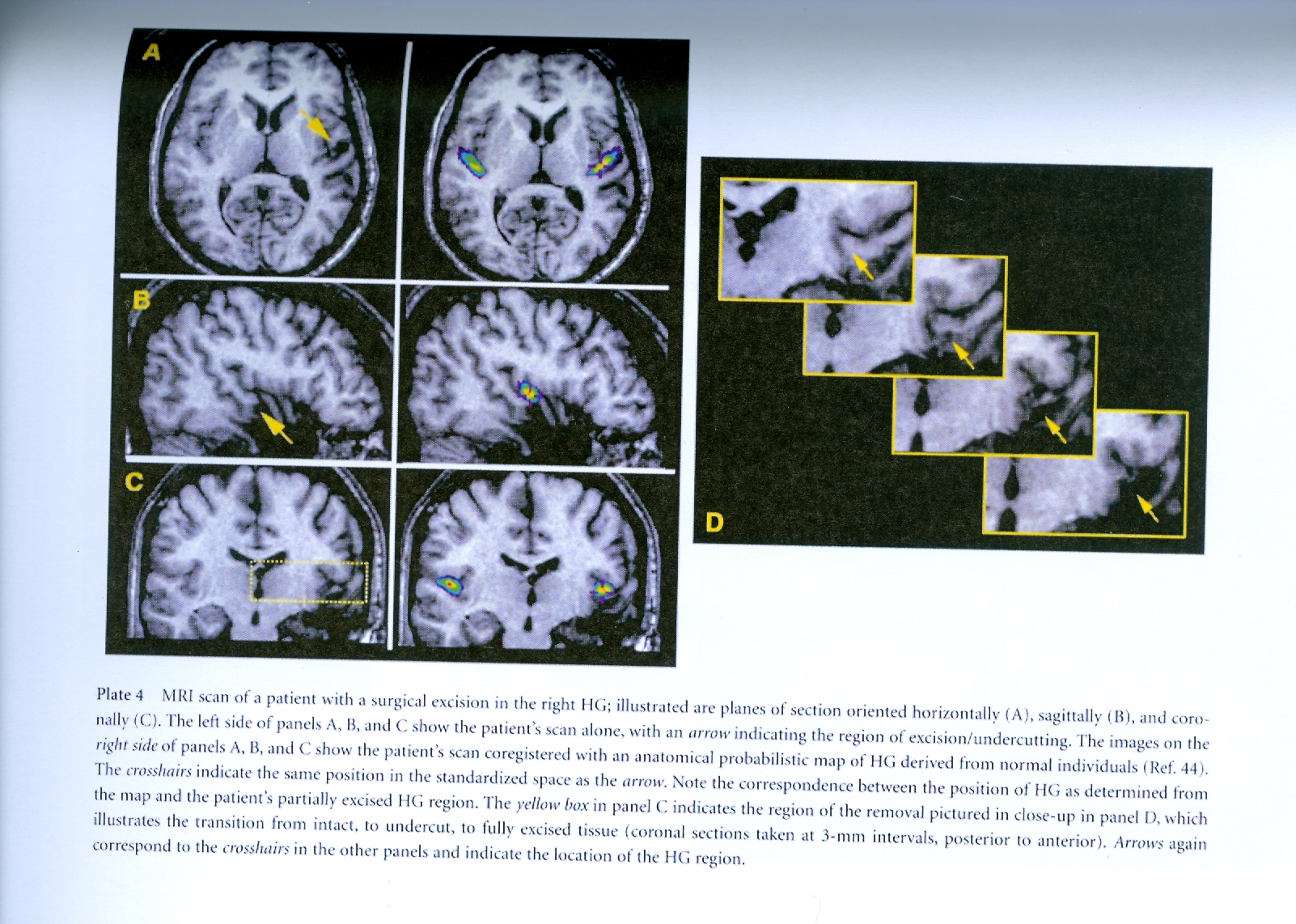
Patients with damage to
this area had larger thresholds for pitch discrimination vs
those with (more
anterior) temporal damage no in this area. Fig 16.3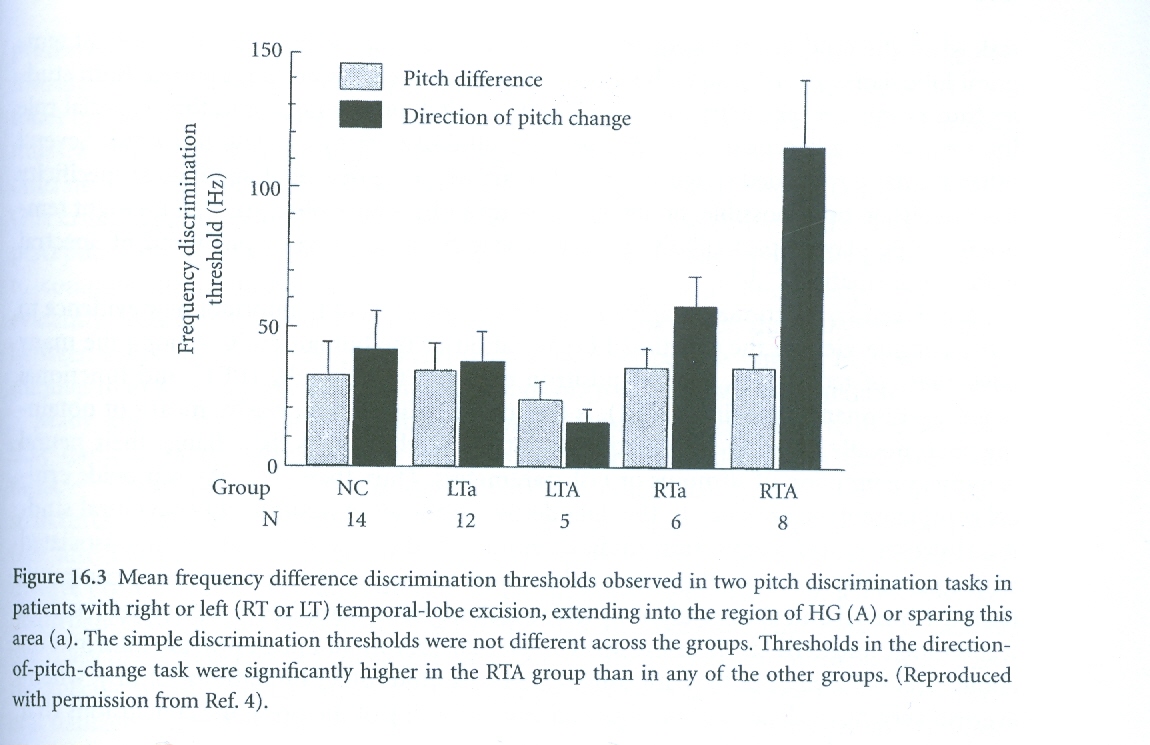
Melodic or pitch pattern processing
requires higher-order cortical areas
and interactions with frontal
cortex.
Ranging from basic interval differences to
meanings they found activity in secondary and tertiary areas.
Imaging studies have shown increased cerebral
blood flow in several motor areas, and
the right
superior temporal gyrus
(STG) has been shown to be important in
feedback during
singing. (found through lesion studies). 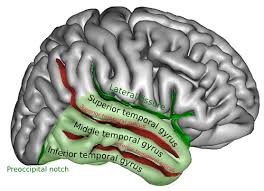
This involves tonal working memory, in order
to compare melodies over time.
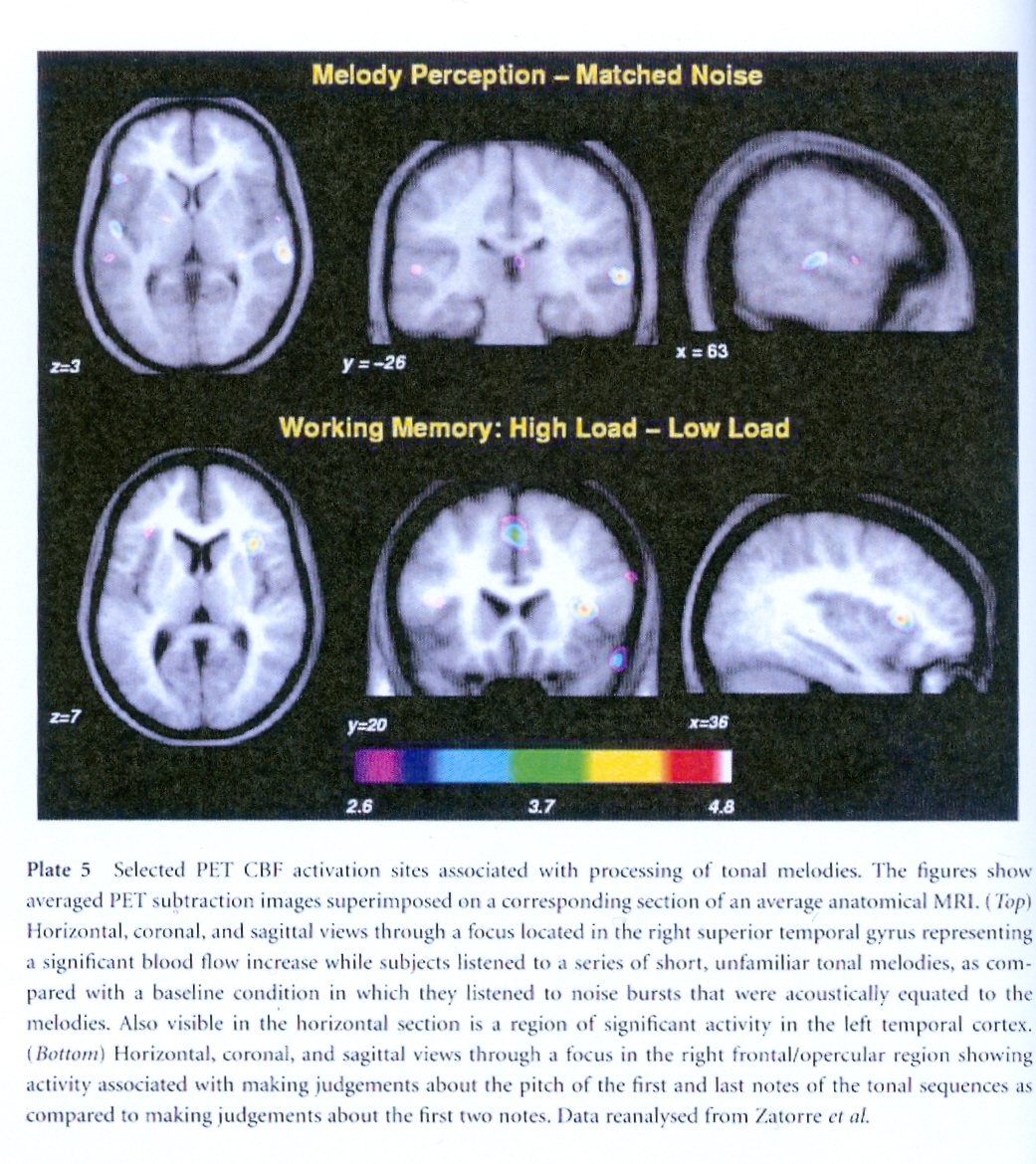
Eg. Zatorre et al PET study with 12
non-musicians listening to:
1) noise bursts,
2) melodies without instruction,
3) melodies and compare first two notes,
4) melodies and compare first and
last notes.
Plate 5 shows
these results show that subtracting passive from two-note condition also led
to significant activation in the superior and inferior frontal cortex.
Functional imaging has shown spectral (tonal)
and temporal parameters varied independently
Structural (lesion) studies of auditory
processes show inter hemispheric differences in grey /white matter
distribution.
Left side has higher degree of myelination
(white matter) for faster processing than right
Left auditory cortex is suited for
fast "broad-band" processing as in human speech
Right auditory cortex is suited for
slower "narrow-band" tonal patterns as in music
Chapter 21 - A new approach to the cognitive
neuroscience of melody.
Patel (p. 325)
What is a melody? - "A group of notes that
are in love with each other" ?
Thirteen ways of hearing a melody
1) Instrument identity - relies on timber or sound quality
2) Grouping - clusters or "phrases"
3) Beat and metre - "sound train" including rests
4) Scale structure - major (Ionian), 2 2 1 2 2 2 1 ; Minor (dorian) etc
5) Contour- overall pattern of ups and downs
6) Parallelism - motivic / thematic similarity structural and perceptual
similarity
7) Intervallic implications - interval-based expectations or
"implication-realization (IR)
8) Tension vs resolution - i.e., 1 2 4 & 5 serve as (ending) resting points
9) Ornamentaion - elaboration on a note (i.e. fluttering or trills)
10) Implicit harmony - "broken chords" successive notes forming a chord over
time
11) Expression - playing with time for emphasis
12) Complexity - structural complexity intuited
13) Meta-relations - several of these factors combining (i.e. grouping and
beat)
www.nsi.edu/users/patel/sound_examples/pz_chapter
Chapter 22 - How many music centres are there in
the brain?
Muller (p.346)
Using Jerry Fodor's modules of the mind approach
have examined many areas of the brain invovled in various tasks (i.e. perception
of contours)
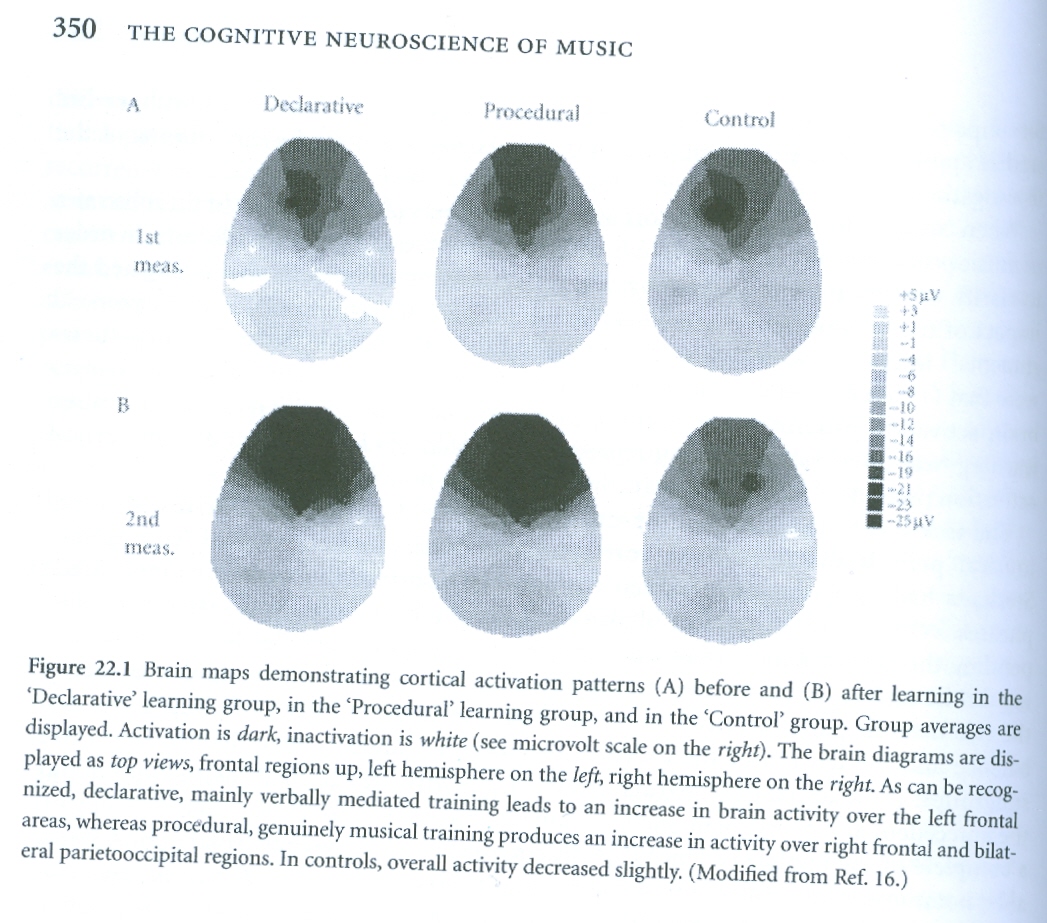
Longitudinal experiment examining procedural
(implicit) vs declarative (explicit) learning styles and their impact on the
brain.
discovered that cortical activation during music
processing reflects auditory "learning biography" of personal accumulated
experience
Listening to music, learning to play an
instrument examined through formal instruction and professional training all
result in multiple, often multisensory representations of music showing
distributed neuronal networks.
1970s Musical training was believed to move music
experience from right temporal to left frontal -temporal cortex.
Peretz & Zatorre have suggested that this shift
is actually the "way of listening to music" whereby musicians engage in "inner
speech" Fig 22.1
Lesion studies have also shown that there are
modules present (i.e. time-left temporal; pitch-right temporal; pitch structures
- right supratemporal)
Rhythm involves processing serial durations while
meter involves a complex acoustical gestalt relying also intensity (emphasis).
Individual data, however, show most variability
across subjects.
Lesion studies show great heterogeneity of
patterns of impairment
Left hemisphere stroke shows impairment of rhythm and metre,
interval or contour, may be anterior or posterior, and may include posterior
parietal lobs as well as frontal lobes.
Brain, Music and
Emotion