where the goal is attune to the harmony of the universe.
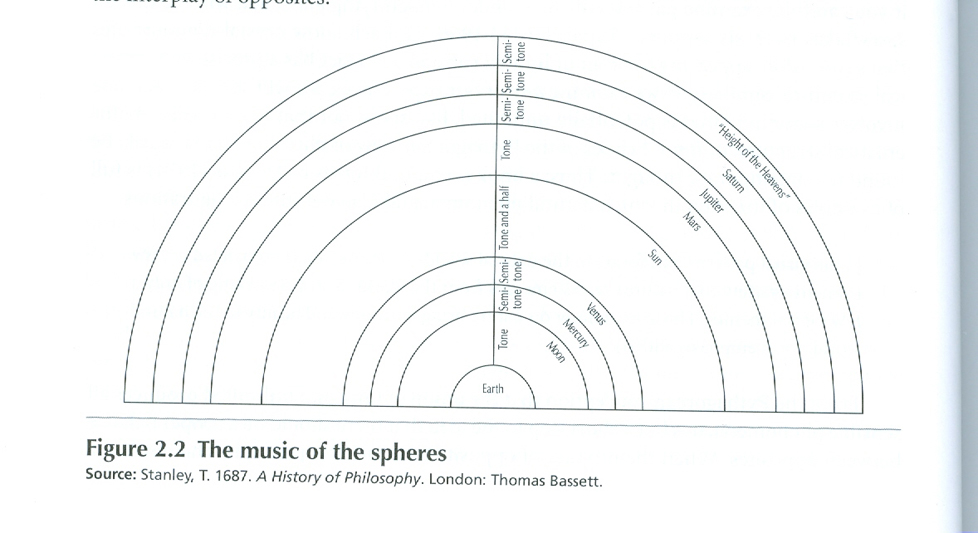
piano
Mathematics is the basis of reality, also seen in music;
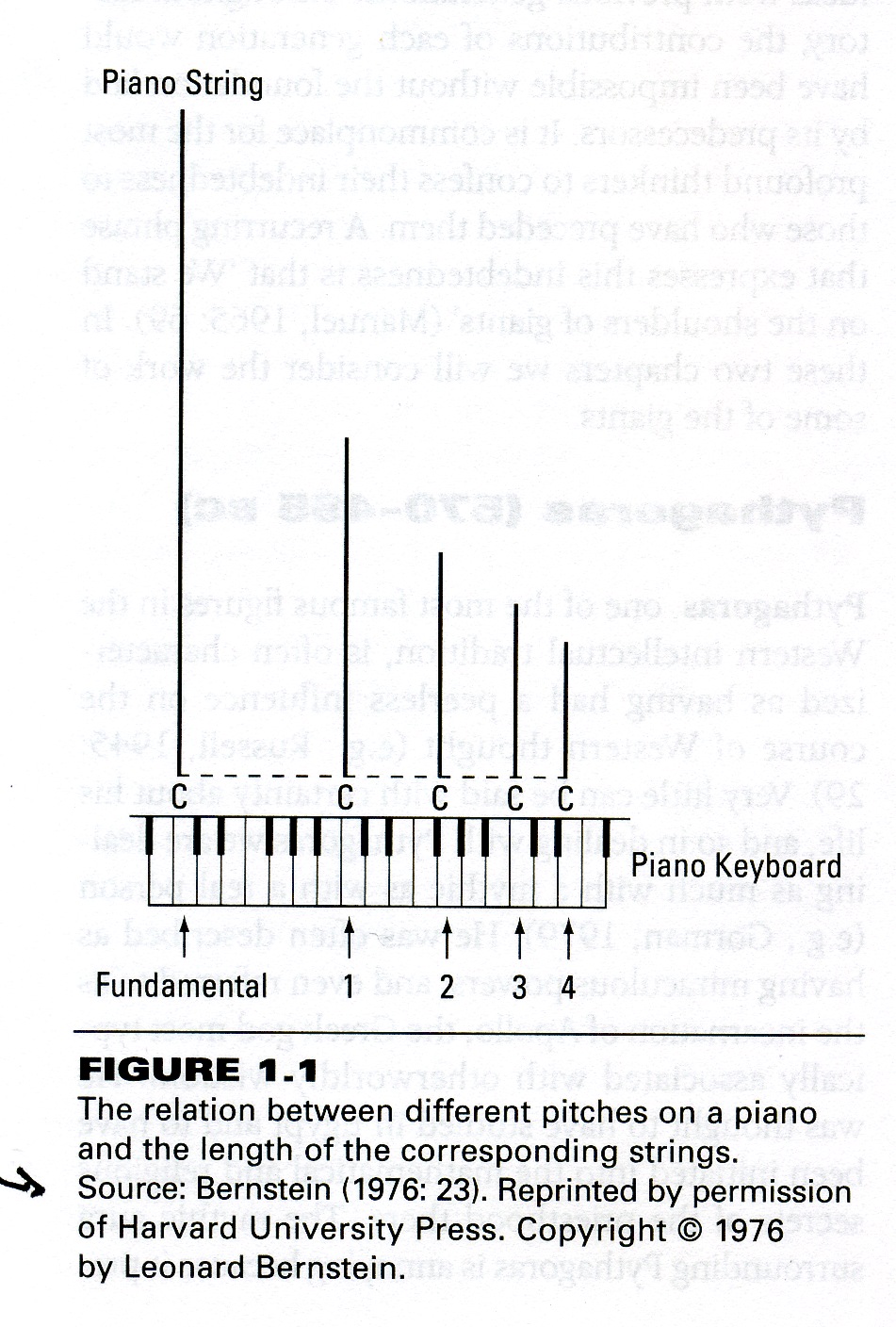
importance of numbers in regulating phenomena (Benjafield, 2006)
Pythagoras - Mystical Numbers and Relations
Pythagoras (570--495 BC)
- Founder of a semi-secrete society
where the goal is attune to the harmony of the universe.
piano
Mathematics is the basis of reality, also seen in music;
importance of numbers in regulating phenomena (Benjafield, 2006)
Cosmology based upon dialectics,

unity differentiated into polar opposites; which are then re-united (harmony).
This is the process of creation, as also seen in biological ontogenesis.
When the correct proportions of opposites are brought together, then an harmonious, union of opposites emerges (see Jung).
Souls seeks the mythic music of the spheres
of life around us,
need to get in touch, becoming sympathetic to the vibrations.
As the world is divided into opposites to be united,
....good-evil; light-dark; odd-even; unity-disunity; square-oblong.....
Limit vs. Unlimited stands as a central pair.....
Limited - placed within limits give about proportion and balance
Unlimited- lacking proportion, out of balance,
Pythagorean Mathematics
Gnomon - 'Carpenter's Square'
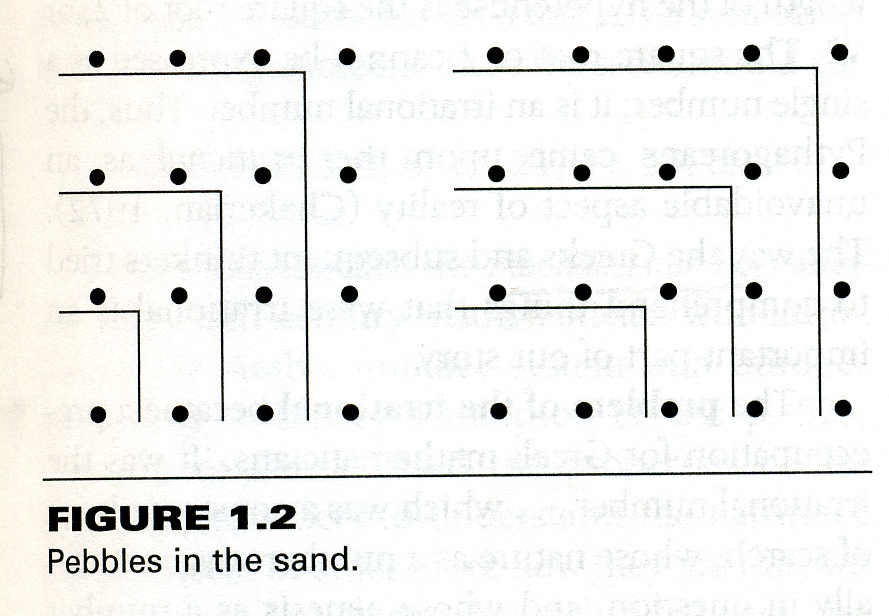
- meaning adding or subtracting of one figure from another figure of
the same shape
(i.e., pebbles in the sand) figure 1.2 (Benjafield, 2006, p.5)
Special Features
- unity - gives rise to the odd
series unity is limited, square, and
odd.
- duality gives rise to even series plurailty is unlimited, oblong and even.
Pythagorean theorem - a2 + b2 = c2
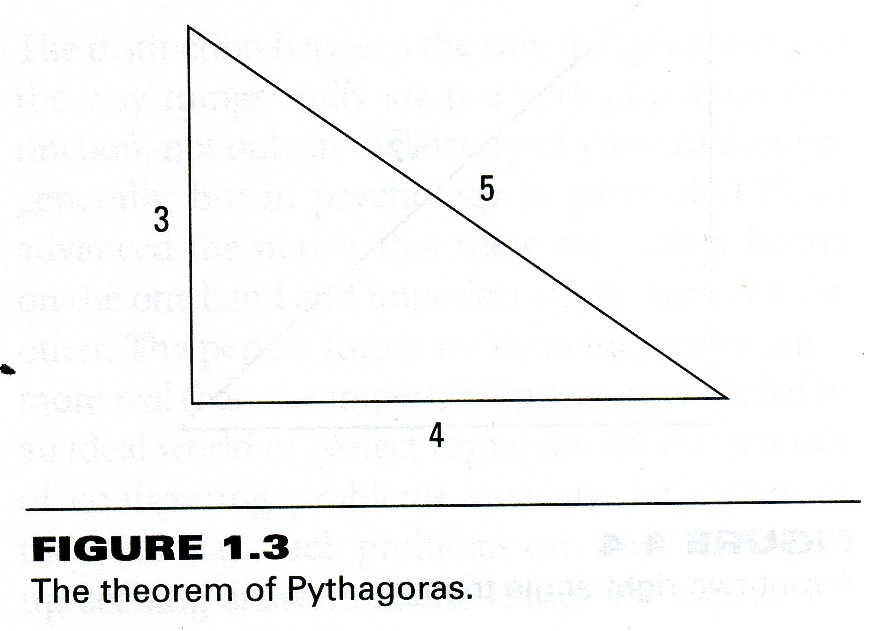
Represents and invariant proportion, always is equal and harmonious.
Donald in Mathmagicland
The problem of the Irrational
-
The Golden Section (0.618)

Benjafield further discusses the Greek pursuit of the golden section and the aesthetics of irrational numbers.
Recall His delineation of the Rational vs. Irrational along with the Limited and Unlimited.
A__________________________B_____________C
Where A-B/A-C =
B-C/A-B = 0.618
Thompson (1929, p. 44; Green, 1995) the Golden Section is approximated by the Fibbonocci Sequence of numbers.
Fibonocci was a 13th century mathematician who brought the Arabic numbering system to Europe.
This sequence of numbers, starting with 0, 1, then making numbers (Xn) by adding the two previous ones (Xn-2 + Xn-1): ......0, 1,1,2, 3, 5, 8, 13, 21, 34, 55, 89, 144, 233, ....
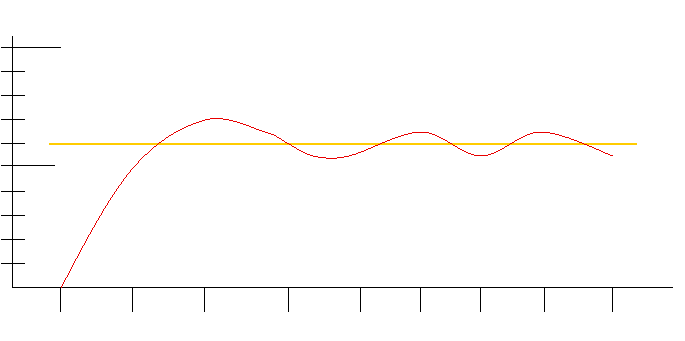
Benjafield points out that as Xn increases, here actually rather quickly, the ratio of any two successive numbers ( X / X n=1) more closely approximates the Golden Section 0.618 (Thompson, 1929, p. 52) .
He further shows this:
| 1 / 2 = 0.5 | 5 / 8 = 0.625 | 13 / 21 = 0.619047619047619 | 34 / 55 = 0.61818181818181818 | 89 / 144 = 0.618055555555555555 |
| 2 / 3 = 0.6666.r | 8 / 13 = 0.6153846.r | 21 / 34 = 0.617647058823529 | 55 / 89 = 0.61797752808898764 | 144 / 233 = 0.61802575107296137 |


 Properties of the Western musical Scale
Plato - Theory of Forms - The perfect world...... Draws from Pythagoras
Harmony -Discord in training the mind and the spirit, along with theatre & arts
Dialectical Reasoning
- Approximates the Truth (Ideal State) as in the Golden Section.
Back and forth comes closer and closer, though regular repeating patterns or
forms.
Benjafield, J.G. (2005) A History of Modern psychology. (2nd edition) Toronto: Oxford University Press.
