
Topic Two (a): Theoretical and Methodological
issues
for the study of psychology and culture
I - Theoretical Issues surrounding culture and psychology
Various Perspectives on the study of psychology and culture
Kuhn (1970) suggests that understanding
science and psychology
is done in relation to various worldviews. Paradigms or perspectives
of science built up like cultural world-views, the cultures of science.
E.g.,
Necker Cube
"Emic-Etic dispute" is central to the issue of perspective
Following Pike (1967), John Berry has described the Emic and Etic orientations.
Emic refers to 'culture-specific' aspects of psychology or experience
Etic refers to universal or 'culture-general' aspects.
In Psychology there is a parallel debate
over personality
as being best known in idiographic vs. nomothetic terms.
Berry et al's Figure
9-3

Goals or interests are contrasting between these views
Eg., Lawfulness (universal) vs. understanding and expression
and causal explanation
Figures
10-1 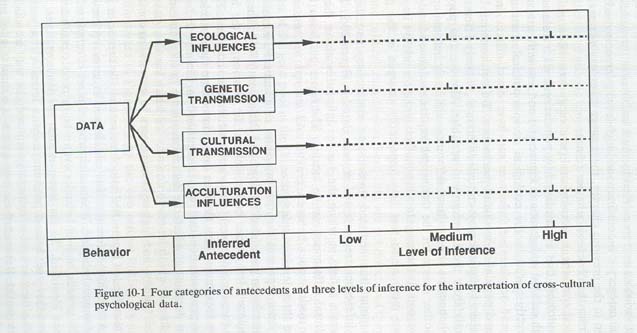 & 10-2

Types of inferred antecedents
can also be considered when delineating the views of:
Absolutism, Universalism,
Relativism. (
Berry et al, Table 10.1)
(
Berry et al, Table 10.1)
Absolutist-not concerned with ethnocentrism
or seeing people in their own terms;
imposed etic
Universalist- basic processes but culture specific
manifestations; derived etic
Relativist- avoid ethnocentrism and
see people in their terms;
emics
Nature vs. Nurture is also an important issue here where often the absolutiststs and universalists may place more emphasis on nature while the relativist is likely to place emphasis on nurture.
Conceptions of culture will have
an impact on the type of studies carried out including the methods.
Recall that
from Tylor (1871), culture is seen as
one of the
earliest definitions.
We also see many others definitions
ranging from:
Descriptive, Historical (traditions), Normative (rules),
Psychological, Structural (organized pattern,
Genetic (origin of culture).
II. Contemporary Theory and Methods in Cross-Cultural Psychology
Berry et al.
(1992) provide several definitions making use of
culture-"the shared way of life of a group of
people" and
its causal relationships to behaviour
and cultural experience,
with a focus on the generalizability of studies
that may be
used to understand cultural change.
This is for the
goal of testing
hypotheses about people,
the universal validity of psychological theories.
Theories
- systems of thought give rise to
Hypotheses - specific statements of what to
expect (predictions)
Hypotheses are disconfirmed (refuted)
by observations (data)
but
Positivism suggests that
verification gives
rise to proof.
(this is a logical mistake according to Sir Karl Popper)
Other goals are revealed as:
1.
Test and transport - take a present
theory or test and transport
it to another culture. E.g., "practice makes perfect" testing
the role of practice on remembering across different cultures.
2.
Explore and discover - Sometimes,
'failures' in the first type
of study become 'discoveries' of differences. Other times
keep eyes (and mind) open to uncover new phenomena
that vary cross-culturally or cross-nationally.
3.
Integrate - to assemble various
studies and theories into
a grand theory or framework of knowledge that accounts
for the similarities and differences observed across cultures.
To generate a universal theory of psychology.
Research focuses on behavioural, biological, and ecological variables
Related forms of study (common to anthropology)
Ethnology
- understand patterns, institutions,
dynamics and changes of cultures, trying to
understand implicit cultural
interpretations
Ethnography - descriptive of
explicit culture
based upon field reports or archives
Designing cross-cultural studies
Berry et al.
(1992): Seldom use the "Controlled Experiment"
across cultures, but still use the language of such studies.
Independent variable
-> Dependent variables.
E.g., Taken at birth
Cultural Identification
Adjustment,
Esteem, ...
Obviously these types of studies cannot be done for ethical reasons,
so true experimentation, which is the best way to determine causes, cannot be done.
As such it is difficult to "rule-out" all possible explanations (causes) so cross-cultural psychologists make use of:
Four strategies to eliminate competing alternatives:
1) a priori selection of participants from across 'societies' or 'cultures'
2) using a aggregate dependent variables: two + scores into one.
3) use of statistical analyses to 'eliminate' the effects of "irrelevant variables"
4) multiple measures: self-report, interview, analyses of life histories.
Make use of convergent and discriminant validation where various studies of methods support each other or conflict with each other.
Based upon such studies cross-cultural psychologists infer antecedents of behaviours
and attempt to test hypotheses derived from theories about those antecedents or causes.
Origins from Psychological Anthropology
(back to history)
Cultural Psychology
and its divergence from Cross-cultural psychology.
